
First Aid for Dental Clinics
Medical emergencies are rare in a dental clinic – which is exactly why they need to be practised. On this special course, the whole clinic team practises recognising the acutely ill patient, giving the right first aid and working together on CPR and the defibrillator until the ambulance takes over. The course is always taught by Jesper Hermund, who also teaches at the School of Dentistry, University of Copenhagen.
Who is the course for?
Dentists, dental hygienists, dental assistants and other staff. The whole clinic trains together, as the team you are every day.
Emergency preparedness is also a standard item when the Danish Patient Safety Authority inspects dental clinics. On the course you practise using your own emergency equipment and procedures as a team.
What you get out of the course
Recognise and manage the acutely ill patient
You learn to recognise the symptoms and give the right first aid for the most common medical emergencies in patients at the clinic.
Resuscitation as a team
You practise CPR and defibrillation with clear roles, teamwork and feedback on quality.
Calling for help and handover
You practise calling 112 and working in a structured way with the ambulance crew, so your efforts fit together.
What the course covers
Resuscitation and teamwork
- CPR and defibrillator in clinical teamwork
- Unconsciousness, open airway and the recovery position when breathing normally
- Calling 112 and handover to the ambulance crew
Circulation
- Chest pain and acute coronary syndrome, including heart attack
- Fainting (syncope)
Breathing
- Shortness of breath and acute asthma
- Choking (foreign body airway obstruction)
Nervous system
- Stroke
- Seizures and epilepsy
Metabolism and infection
- Diabetes-related emergencies
- Severe acute infection
Allergy
- Anaphylaxis
How the course works
The course lasts four hours, split into two 120-minute modules. The training is based on your own premises and your emergency medical kit.
About 2.5 hours are hands-on practice in first aid and resuscitation. The manikins give real-time electronic feedback on CPR quality, and the instructor gives structured professional feedback.
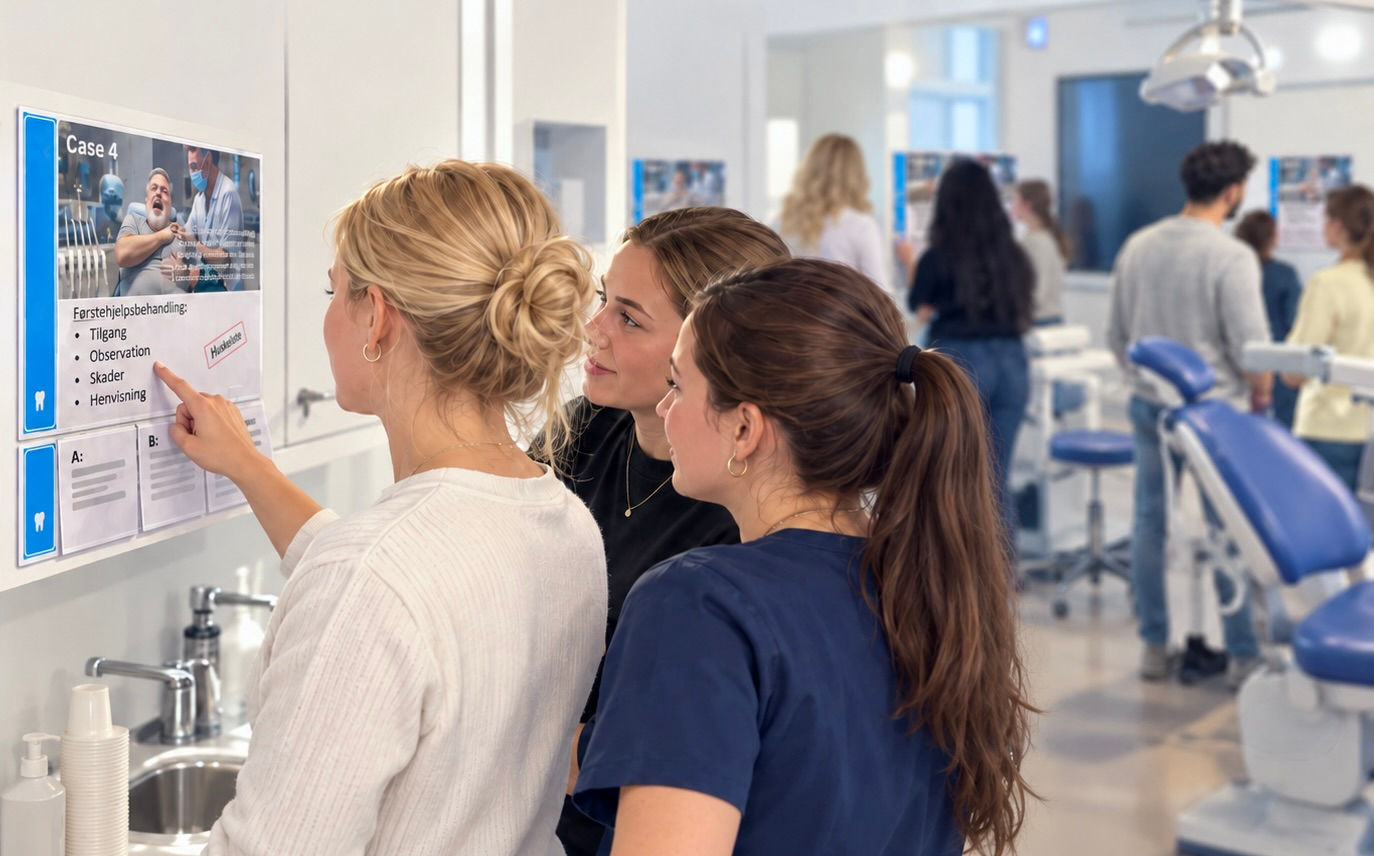
About 1.5 hours are spent on discussion and reflection on realistic scenarios from the dental clinic. With FlipCaseKlinik tasks you work in pairs to observe, decide and act, and compare your choices with the professional reference.
The training follows the guidelines of the Danish First Aid Council, which are based on ERC Guidelines 2025, and takes into account the Danish Patient Safety Authority's inspections of emergency preparedness in dental clinics.
The SimPads log the quality of every CPR session throughout the course, and at the end the day's top three each get a small treat. The point is not to find a winner: the friendly competition makes many people practise extra – and the more you practise, the better you get.
Certificate and continuing education
Each participant receives a course certificate stating the number of teaching hours, which can be registered as continuing education. The back of the certificate shows the course objectives and content. The certificate is issued electronically, and on paper if you wish, and can be issued in English. The course has defined objectives and expected outcomes, and participants evaluate the teaching. The Danish Dental Association recommends that its practising members complete at least 25 hours of continuing education a year.
Keeping your preparedness up to date
Review roles, the emergency kit and skills at least once a year, for example at a staff meeting, and make a note that it has been done.
Short training sessions spread over the year keep skills up to date. We are happy to help with the annual check.
We recommend a refresher course at least every two years, and whenever new national or international guidelines are introduced.
The instructor
The course is always taught by Jesper Hermund. He has more than 25 years’ experience as a first aid instructor, specialises in dental clinics and teaches at the School of Dentistry, University of Copenhagen. He has attended the European Resuscitation Council congresses since 2009 and follows developments in the resuscitation and first aid guidelines closely. Read more about Jesper
Questions about the course
Does the course count as continuing education?
Yes. Each participant receives a course certificate stating the number of teaching hours and can register the hours as continuing education.
Can the course be shorter?
Yes, a shorter course can be agreed. The standard course is four hours.
How much of the course is hands-on practice?
About 2.5 of the four hours. The rest is discussion and reflection on scenarios from the dental clinic.
Do you come to the clinic?
Yes. We train in your own premises with your own emergency equipment.
How often should we take a refresher course?
We recommend at least every two years, and whenever new guidelines are introduced.
Which training manikins do you use?
We use Resusci QCPR manikins from Laerdal in adult, child and infant sizes. They measure the depth, rate and recoil of chest compressions, how much air goes in with each rescue breath, and whether you are pressing in the right place. Participants see their results as they go on their own SimPad and can correct themselves straight away. The chest has realistic resistance, so you feel how hard you need to push. The manikins are designed for professional scenario and team training, so participants can also practise working together when several people are helping at once.
Can the course be taught in English?
Yes. All our courses can be taught in English. Mention it in your enquiry.
Other courses
Shall we find a date?
Tell us about your group and your wishes, and we will agree on the course, venue and practical details together. There is no obligation.
+45 30 23 30 37